What To Look For In A Triathlon Coach

Joining up with a good triathlon club is a great way to facilitate improvement in your training and racing.  Another great way to take things up to the next level is to hire a coach.  A good coach is someone who can work with you, understands what you are capable of, and can push you to limits that you might not reach on your own.  They will also be there to pull you back and keep your workouts in check so that you don't overtrain or overextend. 

As a certified USAT Coach  I've had the pleasure of working with a number of coaches over the past couple of years and I've learned quite a few things that I should absolutely do.  I've also learned a number of things that should not be done. 

So, what, as an athlete, you should expect from a coach?

Training sessions (group or one on one) aren't the time for the coach to get their own workout in.  You're paying for the coach and they should be there for you, the athlete.  In the case of a one on one training session, this mean that your coach will ride or run at your pace.  In the case of a group training, it means the coach is going to bounce from the middle of the group to the back of the group and then to the front of the group to check on all athletes.  More importantly, if it's a large group session, your coach should have some assistants with him or her to ride or run with all the pace groups.  Likewise, your coach should not be swimming during your individual or group training sessions.

One workout doesn't fit all.  With a group training session, regardless if it's swimming, cycling, or running, a coach should be prepared to offer different workouts for each athlete  to meet the variety of  abilities in the group.  One workout isn't always going to work for everyone.  A coach should understand who is in attendance and what their individual needs and abilities are. 

He or she should be humble.  If you ask your coach about his or her experience at a race you're considering they should be focused on you and your needs.  They shouldn't give a race history and elaborate ad-nauseam on past results unless you're asking for that information.  The coach is there for you. When asked about a specific race, if applicable, the answer needs to be "…yeah, I've raced there (or know someone who has) and that course has a challenging run course -  We'll need to work on hills so you're prepared".  The answer shouldn't be "…I smoked that course and PR'd….let me tell you about my day".

Your coach should have the resources and tools that are required.  Your training should include analysis of your bike fit, running gait, and swim stroke.  Your coach should be able to analyze your biomechanics.  The necessary tools and resources need to be available and they should be readily at their disposal. 

Logistics.  If your coach has to drive a fair distance to get to a group training site, or to meet an athlete, you shouldn't  be reminded of your coaches commute.  Whatever arrangements were agreed upon for training locations and times should be maintained.  Trainings and meetings shouldn't be altered or changed unless unforeseen circumstances dictate.  And you, the athlete, shouldn't be made to feel guilty for your coaching having to drive at an ungodly hour to meet you for a swim session.

New ideas aren't bad ideas.  If, as an athlete, you present a new idea or thought to your coach it should not be met with resistance or negative feedback.  Open discussions and conversations are critical to a successful athlete / coach relationship. Suggestions and new ideas to training should be met with openness and discussion.  Benefits and drawbacks weighed.  Explanations for decisions should be clear and agreed upon.  Both sides should be open to suggestion. 

Most importantly, you should choose a coach only after meeting and having a discussion with him or her.  It's an interview process and both parties need to be sure that it's a good fit.  As an athlete, you have every right to inquire about a potential coach’s credentials and certifications as well as how they work with their athletes and what their philosophies are and how they relate to your goals.

Your coach’s top priority should be you.
How I Moved From The Middle Of The Pack To The Podium

When I started competing in triathlons I have to admit I didn't exactly know what I was doing.  That's not to say I didn't have structured workouts.  I did.  I was working out with a local running and triathlon club.  I was working hard.  I was training hard….and I was improving.  As a relative beginner (even, at the time, in my second full season of racing) I was still seeing improvements, but the gains weren't as significant as they used to be.  On the flip side, I had moved from struggling to keep up on morning rides to leading the group rides and being able to keep up with the more proficient runners in the lead pack of the group runs.

My improvement overall was starting to slow.  My wife had been suggesting that I join another triathlon club in the area for a workout or two.  I'd been invited to join them for a group ride, but never acted on it.  I was training with a club that was more local to me and I was comfortable.  But I was honored, actually, to have been invited to join this other group.  They were all great athletes.  The previous year they had five individuals qualify for Kona.  Truth be told, I was intimidated. 

Finally, after a month or so had gone by, my wife gave me a good talking to.  "You've gotten all you're going to get out of this club.  You need to train with people that are better then you."  This wasn't a dig on the group with which I was running, riding, and swimming.  They were great people.  I learned a lot, and improved significantly from when I first began competing in triathlons.  But, I'd reached a point where I needed more.  The writing was on the wall: it was time to exit my comfort zone.

I reached out to our mutual friend who had extended the invitation (and ran the club at the time) and arranged to meet up with him and his club the following Saturday for their regular group ride.  Upon arrival, and during introductions, I remember thinking that everyone was really nice.  They were joking around and there was a casual atmosphere. We started our ride easy to get loose and I was feeling pretty good.  This seemed relaxed.  "Maybe this won't be so bad,"I thought.

That feeling of confidence soon departed.

Ten miles into the ride the pace had picked up to what I would have normally, up until a week previous, considered a hard ride.  They were all still talking and joking with each other.  I was barely able to get a drink of water without falling off the back of the pack.  Five miles later I was trying to figure out how I was going to eat the Hammer Gel in my jersey pocket without being dropped.  My friend Rich, who invited me along, would come back to the tail end of the pack to check on me.  Between gasps I said I was good.  I remember him telling me: "Stay in the draft - you're doing great!"  Really?  This is "doing great"?

This went on for another 15 miles.  At one point I knew we were headed back and the suffering was going to end soon (well, in another 10-15 miles).  But then we hit the really hilly section of the ride.  I prayed for death.  My heart rate was pushing my theoretical max.  My water bottles were empty.  How can these maniacs keep talking and joking around on a climb like this?  How do I ask these people if I can have some of their water?  I finished the ride, went home, and slept for 3 hours.  How was I going to run with them the next morning?  How was I going to convince myself to ride with them the following weekend?  Somehow, I did. 

I kept going back.  I refused to let myself be dropped from the pack.  As much as it hurt, I wasn't going to let them leave me behind.  I worked my ass off that first day - and again over the next handful of weekends.  I don't know exactly when it happened but suddenly, on a typical Saturday group ride, I took my first turn at the front of the pack for a pull at the front of the pack before dropping back to rotate forward again.  My average speeds for the 40-50 mile rides were now faster than my previous average speeds for 15-20 mile rides.  To that point, I had more 50-mile rides in my first month of training with this group than in my entire cycling career. I had exited my old comfort zone and challenged myself.  Improvements came. 

Running with this group was the same.  Long Sunday runs were done with more intensity than I was used to.  I had to shorten my first few runs with this new group, but soon I was able to stay with the pack for the full mileage - with some  extra hills thrown in for good measure.

In past races I would normally finish in the middle of the pack of my age group.  In my first race after training with my new club I finished 3rd in my age group.  Wait, a trophy?  This was a game changer.  Suddenly all the races I'd done in the two years past took on new meaning.  Revisiting these races and finishing in a place I'd never envisioned myself in was surreal.  A first place age group finish was not only a possibility, but was actually happening.  Top 10 overall finishes were suddenly a possibility.  How and when did this happen?

I'll tell you how it happened.  I got out of my comfort zone.  Training with a group is a great way to get motivated and improve your training. You push yourself, as in any sport, by training with people who are better than you.   This isn't to say that you can't push yourself when training solo.  You can - and you actually need to learn how to do so.  There will be plenty of early mornings at the pool or the track when you need to keep the intensity at a painful level.  But being challenged by others - being forced to work harder than you thought you previously could - is what's going to help facilitate physical, mental, and strategic improvements that you previously didn't think were possible.

It felt great to always be in the lead on group rides and the strongest swimmer at open water swims with my old club  But improvement stopped. By joining a more advanced group I had to challenge myself and struggle at the back of the pack again.

My advice? Find that advanced club and leave your ego at the door.  Leading a group ride feels good.  But improving feels better.


A Look Back

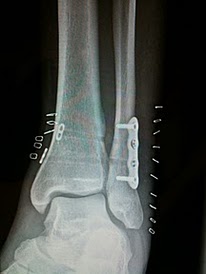
2011 has been an interesting year, to say the least.  I began the year in great shape, with big racing plans, and was primed for a busy season.  This wasn't to be, unfortunately, as an ankle break in mid-February derailed my racing plans for the year.  I did a bit of writing on the topic (I did have a little extra time on my hands) and the following posts pretty much cover the ins and outs of the adventure.

The Dangers of Winter Running - Part I
Plates, screws, and Bone Sutures
Recovery, Rehab, and Thoughts on the ER

Needless to say my training this winter will involve a few more trips to the gym to use the treadmill when the roads might be a little suspect.  I don't need a repeat of this:

Ouch

The downtime this year did, however, give me the chance to be introspective and really look at how I want to be involved in the triathlon community moving forward.  I've been coaching a handful of athletes for a couple of years and have really enjoyed the time and effort that goes into the process.  More to the point, the satisfaction that I get from helping an athlete achieve their goals is more than I could have ever imagined.   I also had some time to look back on how I got hooked on triathlons. 

How it all Started: How I Became A Runner
From Running to Triathlons

More importantly, I thought more and more about coaching.  I took advantage of the free time and became a USAT certified coach.

Hey Coach!
USAT clinic recap

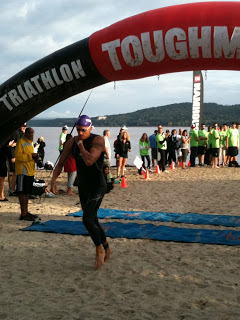
Since the clinic, it's been a busy year.  I worked a few triathlons - I think it's good to give back to the triathlon community and marshal / work a local race or two each year.  Most notably I was on the race staff for the Toughman Half Ironman.  It was a long weekend but it was well worth the time and effort.  Triathlons just can't be held without the help of volunteers and the tireless hours of the race organizing committee. 

Back on the coaching side of the house, it was equally as busy.  While all my athletes did well and achieved their goals, one of my athletes really had a great year.  Not only did she take overall Master (and 2nd woman overall) at her hometown race, but she had a PR at Steelhead 70.3.

Clark Lake Triathlon Recap

Her performances this year, along with the accomplishments of my other athletes, confirmed my desire to coach and make this a career.  It'll be a long road but I think I'm on the right track.  I'm working with a USAT Level III coach who is acting as a mentor and I've also been hired by Team in Training to coach the area triathlon team.  For this, I became certified at the Dave Scott coaching clinic just last month.  (I have yet to write about that experience - I'll report on that soon enough, I promise.)  But, I did get to meet the legend.  He's humble and generous with his time.

Dave Scott is on the left. I'm the short guy on the right (just in case you weren't sure!)
And finally, there were some interesting happenings in and around the running and triathlon community that I either experienced or wrote about.  So, going back through 2011 (and a couple posts from late 2010), here are a few links that I thought might be worth revisiting.

My Problem here is with the "Noodle"
Managing Life and Triathlons
Support in Injury and Health

And based on my run this morning - and two incidents with drivers who were just not paying attention - I thought this would be worth a second look: Common Courtesy - An Endangered Species

With that, it's now time to put bad mojo behind me and look forward to a busy, upcoming race and coaching season.  I hope everyone has a wonderful 2012 - full of health, fitness, and good racing. 

Gail's Trail Race Recap

 .....or "What a Difference A Year Makes"

It was a nice morning for a December trail race.  20F at the start up in Redding, CT.  People that had run this race before were looking forward to the single track, water crossings, and mud.  New participants were asking a lot of questions about what they'd gotten themselves into.  Much bigger crowd compared to years past.  But more on that later.

I wrote about this race last year and I've had three good years racing at this event.  This year, however, not so much.

I didn't bother wearing my heart rate monitor, as I was instructed to "not race" by my lovely wife.  She has a good point with that bit of instruction: My ankle just isn't quite up to full 'blasting through trails' fitness yet, so I never planned on trying to duplicate my efforts from last year.  I felt calm and relaxed as we warmed up, and was content to just "run" it and have a great time.  However, it wouldn't have mattered what my original plans were.

Fitness, or lack there-of, really showed.  I never felt good....not even at the beginning.  The hills were just crushing.  Last year, by the first 'peel off' into single track, I was amongst the top 5 runners.  This year as we headed into the woods I might have been lucky to be in the top 20.  I just never got into a groove.  It's a good thing I didn't wear my hear rate monitor as I'm pretty sure I would have seen my theoretical max today. 

By the end I was absolutely ready to stop running.  Quads were barking….lungs were burning.  I thought of my triathlon this past October and how good I actually felt after an entire season on the bench.  Heck, I even had a good result at that race.  Have I fallen that far off the fitness wagon?  Clearly there's lots of work to do this off-season.

But, let's not stray too far from the facts: This is a great race.  The folks over at Team Mossman really put on a nice event here.  The course was marked "just enough" for a trail race, and there was plenty of mud and water to keep things interesting.  Some of us were a little, what's the word here:  Disappointed?  Not sure.  But the race has grown from a small event with 40-50 die-hards, to close to 150 people this year.  While we were sad to see our niche race become more mainstream, this is great news for Team Mossman.  Great events will always draw crowds.

Anyway…..I was home by 1000a, and having a nice breakfast and coffee by 1030a.  A premium nap followed.  Not a bad way to spend a Sunday morning.

Toughman Half Iron Triathlon 2011 Photo Gallery

Apologies for the massive delay, but below are a handful of pics from the Toughman Half Iron Triathlon .  As previously mentioned I was working over the race weekend, but did manage to get some photos in throughout race day:

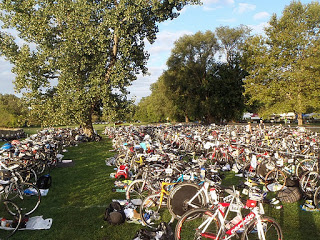
Transition area - Athletes are headed to the beach

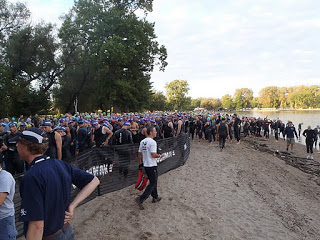
Athletes on the beach - Race is about to begin

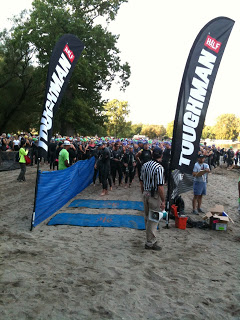
Countdown to the first wave

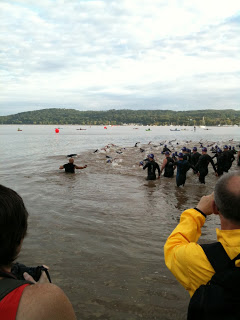
Elites and M40-44 into the water

First swimmer out of the water

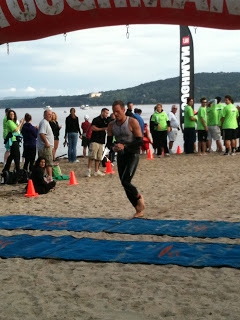
Second swimmer out of the water

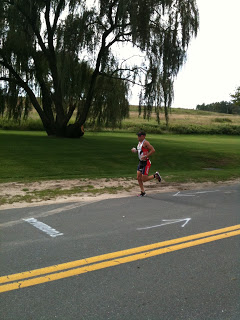
First elite / pro onto the run (This guy smoked the course - overall winner)

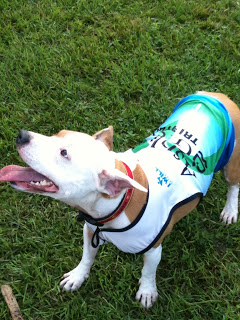
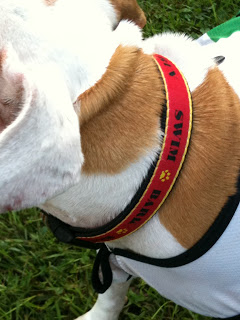
The fan fave - "Tri-Dog"

Collar reads: "Swim - Bark - Run"

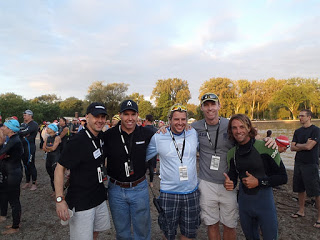
Some of the race staff at the start (I'm on the far left)
I would have had more pics during the bike leg, but we were crazy busy as the athletes came into T2 - controlled chaos in that last 1/4 mile!  It was tough to have my iPhone out and at the ready while working and racing around all morning.

Great feedback from athletes post-race as well.  Always encouraging to hear kudos from people that are racing.  Makes all the hard work and lack of sleep that weekend well worth it.